Interview with Okuvision CEO Dr. Alfred Stett

Dr. Alfred Stett, CEO of Okuvision GmbH, shaped the development of transcorneal electrostimulation (TES) from early research concepts to patient application. In this interview, he discusses how Okuvision was founded in 2007, the technical and clinical challenges involved in developing a practical therapy, what motivates him personally, his vision for the future, and how manufacturing and studies are organized. The conversation provides an authentic insight into the journey from neurostimulation to evidence-based care.
How did Okuvision come to be founded?
Okuvision was founded in 2007 by Retina Implant AG. At that time, there were initial indications that electrostimulation in the eye had a positive effect on the preservation of retinal cells. Retina Implant, which developed an implantable electronic chip for the blind, decided to also develop a therapy that would have a neuroprotective effect without a retinal implant.
What fascinates you about ophthalmology? How did you come to this field?
I came to ophthalmology through this retinal implant. At that time—it was 1996—I had just completed my doctoral thesis at the Max Planck Institute in Martinsried/Munich and received my PhD in physics from the University of Ulm. My research focused on coupling chips, like those used in computers, with nerve cells. The background involved questions about brain-computer interfaces. I conducted extensive experiments with leech nerve cells on silicon chips and investigated fundamental questions about electrostimulation. Then my doctoral work ended, and at that time the retinal implant project had begun here in Tübingen and Reutlingen. I applied, was accepted, and started as a postdoc at the Eye Clinic in Tübingen. Soon I had my own laboratory at the NMI in Reutlingen, where I could continue electrostimulation research in connection with the retinal implant. That’s how I came to the field of electrostimulation in ophthalmology.
What challenges have there been or are there since Okuvision was founded?
There were and still are two main challenges. First, the question of how to electrically stimulate the retina without invasive intervention in the eye. The primary goal was to develop a neurostimulator and electrodes that are safe to use and easy for patients to apply. This is a challenge—both technically and from a regulatory perspective.
And the second is the disease we are treating, which progresses very slowly. Patients with Retinitis pigmentosa often experience no changes for extended periods, and then sometimes very rapid progression. This means that when developing a therapy for a disease that deteriorates or progresses very slowly, there is always the challenge of how to measure the effect of the therapy on the course of the disease. And this still presents us with the challenge today of having suitable methods—in clinical studies we call them suitable endpoints—that are appropriate for clearly demonstrating the efficacy of electrostimulation.
"My vision is to advance Okuvision to the point where we can offer a therapy worldwide that is evidence-based and thus available to many people who are threatened by these diseases."
Dr. Alfred Stett, CEO of Okuvision GmbH
What motivates you to advance Okuvision?
That’s a very good question. My approach has always been to participate in something I consider meaningful, where there is the opportunity to bring ideas from research into development and then into application.
Vision is a very important sense. We humans take in approximately 80 percent of sensory information through sight. When you consider what it means to go blind, the consequences are extremely severe. Everyone can try navigating their environment for a few hours with their eyes closed—it’s an impressive experience. It is therefore a very motivating task to develop something that actually goes into application as a therapy for people suffering from a disease that can lead to blindness.
What vision do you have for the future of Okuvision?
I believe Okuvision has the capability and opportunity to further develop the therapy so that it benefits many people. And my vision is to advance Okuvision to the point where we can offer an evidence-based electrostimulation therapy worldwide, making it available to many people affected by degenerative retinal diseases. We don’t want to limit ourselves to Retinitis pigmentosa, but also want to find out whether transcorneal electrostimulation is also effective for glaucoma and age-related macular degeneration.
How were the OkuStim® therapy and the device developed?
When developing a medical device that introduces energy into the body, you must first develop a device that is safe to use. This must then be demonstrated in laboratory tests and later in clinical studies. Okuvision developed a prototype relatively quickly after its founding, with which clinical studies could be conducted. The first product received the CE mark as early as 2011. Additional studies followed to demonstrate the safety and therapeutic efficacy of the application.
The path to a new medical device begins with requirements that arise from the therapy and practical application, and creating a development plan for a medical device with a specific intended purpose. What criteria must the product meet? Which standards must be satisfied? How can functions be verified and demonstrated that all standards are met and that functions and safety are also ensured in application? The development of the new OkuStim system with mechanics, electronics, firmware, and software was carried out according to our specifications by a development partner. Then it always involves evaluating results from clinical studies in which the safety, function, and benefit of the medical device have been verified. At the end, there is the review and confirmation of the product’s conformity with the rules of the Medical Device Regulation by a notified body and the CE marking of the product.
How and where is the device currently manufactured?
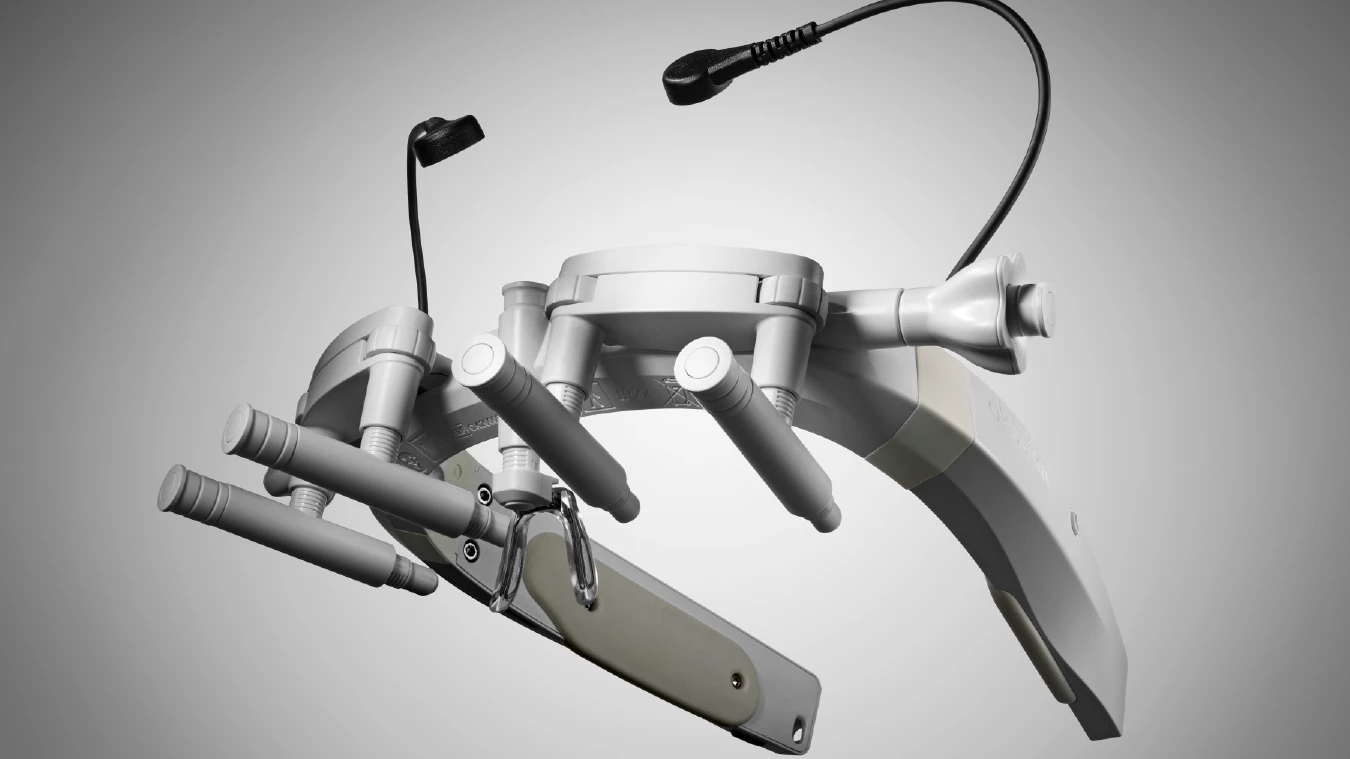
The OkuStim system consists of three components. First, the electrodes that are placed directly on the eye. They consist of a thin silver filament with appropriate contacts and are intended for single use. We manufacture these electrodes ourselves here in our company premises in the Tübingen-Reutlingen Technology Park. We have high standards for cleanliness and quality. We can best meet these in our own facilities. Then there is the actual OkuStim device itself, the neurostimulator, which delivers the current for stimulation. We assemble this here from components that are supplied to us. We build the device, test it, and then release it for sale. There is also software that is used for programming the device and for recording patient data in the clinic.
What studies have been conducted on the OkuStim® therapy and what were the results?
The very first study, the so-called EST 1 study at the Eye Clinic in Tübingen, was conducted very early, even before the CE mark was obtained. The goal was to get an idea of what could be achieved with electrostimulation in Retinitis pigmentosa. At that time, only 24 patients participated in the study, and it was shown that the visual field improved. This was followed by a second study in Tübingen, EST 2, in which over 30 patients received TES for one year and 20 patients received placebo stimulation. Positive effects were seen in the electroretinogram (ERG), that is, in the function of the photoreceptors. However, the results for the visual field were not conclusive. But we were able to show in a post-hoc analysis of the results that with sufficiently strong stimulation, the visual field deteriorated more slowly than in the control group. A slowing of progression means that the decline in vision is slowed and the point at which vision loss seriously affects daily life is postponed to the future.
Then there was the Europe-wide TESOLA study. This explicitly examined the safety of application in nearly 100 patients who used the OkuStim therapy at home for six months. There were no serious adverse events. The most common side effect is that patients experience dry eyes. However, this can be prevented or treated very well with eye drops. No frequent side effects other than these dry eyes are known from all clinical studies conducted to date on electrostimulation of the eye. By now, approximately 500 patients with Retinitis pigmentosa have participated in the studies and have collectively performed more than 3,000 hours of transcorneal stimulation. There were no so-called “Severe Adverse Events” (SAE), that is, side effects that would have had to be reported, so transcorneal electrostimulation is now generally considered safe.
What is still missing is proof of long-term benefit, that is, whether the therapy also leads to a significant slowing of disease progression over several years. This question has been investigated since 2021 in a study involving 17 eye clinics throughout Germany. Over 140 patients have been enrolled, all receiving stimulation for three years. This so-called Trial study will be completed in spring 2026, and the evaluated results will be available sometime in 2027. We hope, of course, and expect that this evidence will be provided. Then the costs for the therapy can be covered by health insurance funds.
How well known is electrotherapy for RP and what should change?
Electrostimulation for RP and other retinal diseases has been known for a very long time in various countries, but there are very few meaningful clinical studies with clear results. In Germany, we have high awareness among patients for our OkuStim® therapy—through our own clinical studies and not least through collaboration with patient organizations. This also applies to Switzerland, where we also have many users. Our clinical studies and self-pay offering have enabled us to build strong relationships with ophthalmology clinics.
Unfortunately, not all ophthalmologists are yet aware of the therapy. We are working on that. We are increasingly present at trade shows. Important communication channels are social media such as LinkedIn, Instagram, and Facebook, so that awareness is steadily increasing and the availability of the therapy becomes better known.
And what else needs to change? Of course, coverage by health insurance companies, so that those affected do not have to pay for the therapy themselves.
What kind of response do you receive from patients and from partners or physicians?
We receive a lot of feedback from patients, including many questions about application and safety, availability, duration and costs of treatment. Interest is high, as there is no other therapy for people with Retinitis pigmentosa.
Some patients who use the therapy for longer periods report to us that through the therapy or immediately following stimulation they have better contrast vision, meaning visual acuity is improved. We want to investigate these subjective experiences more closely in another study. Overall, we have a good impression of the acceptance of the therapy among patients. Although it must also be said that not all patients benefit from the therapy to the same extent, as is the case with all therapies, and not everyone managed well with the previous device.
We are in dialogue with physicians who tell us about the still unmet need for a therapy for Retinitis pigmentosa. And physicians also tell us that they are not yet fully convinced of the therapy, although patients also report to them that they experience benefit. I believe that acceptance among physicians will change when the large study running in Germany demonstrates the long-term benefit of the therapy. Then demand for the OkuStim® therapy will increase and the therapy will gain even more acceptance.