
Retinitis Pigmentosa and Mental Health: What Helps

Why RP Affects Mental Health
Retinitis pigmentosa (RP) does not “only” affect the eyes, but all areas of life – from work and mobility to relationships. Studies describe a high psychosocial impact, partly because RP usually begins early, progresses slowly, and is incurable. Therefore, psychosocial coping strategies, education, and the maintenance of independence are part of care from the very beginning.1
In a survey, 92% of those affected stated that RP influences their mental health.1
Common Feelings & Symptoms – and How to Categorize Them
At the beginning, shock, anxiety, and uncertainty often dominate. Later, the narrowing of the visual field can noticeably restrict daily life: things like reading, finding one’s way, sports, or driving become more strenuous – in studies, this correlates with lower quality of life, more anxiety, and depressive moods.1
Independent of RP, studies on visual impairment also show: less visual function is often associated with more symptoms of depression and feelings of anxiety.2
Important: Feelings are understandable – and can be influenced. Write down your biggest hurdles (e.g., glare, twilight, orientation). This is exactly where help comes in: technology, training, environment.1
Charles Bonnet Syndrome: Concerning, but Explainable
With significant vision loss, visual hallucinations can occur (Charles Bonnet Syndrome) – up to 1 in 3 adults with advanced RP report this. This has nothing to do with “being crazy,” but rather with sensory deprivation. Speak openly about it during your consultation – shame unnecessarily prevents people from seeking help.1
What Studies Recommend: Education, Structure, Support
Education & Counseling. Medical teams should actively address psychological aspects, explain supportive offers, and – if necessary – refer patients to primary care physicians or counseling. Regular check-ups (usually every 1–2 years) make the progression predictable and provide security.1
Peer Support. Contact with self-help groups improves coping, function, and autonomy – and relieves the burden on those around you.1
Rehab & Low Vision. Magnification, edge filters, lighting, orientation & mobility, screen readers – intended as structured rehab, not “random finds.” This increases the scope for action and reduces stress.1
Involving the Family. Relatives learn to recognize warning signs of depression and react constructively.1
Perspective Through Preservation of Function – Briefly on TES (OkuStim®)
Many burdens arise when visual function is lost. Therefore, preservation of vision is a central goal: studies on transcorneal electrical stimulation (TES) suggest that visual field loss in RP can be slowed down.3
The team concludes: if the annual loss is halved, the “half-life” of the usable visual field mathematically doubles – including the potential to permanently improve quality of life.3
Important: TES does not cure RP. Whether TES is suitable for you is determined by an eligibility assessment (goals, dose, follow-up checks). Details on our TES page.
Everyday Toolbox: 10 Concrete Strategies
- Establish routines (fixed check-up & training times). Repeatability reduces stress1
- Optimize light & contrast (at home/work)1
- Test edge filters/magnification/screen readers – have them professionally adjusted1
- Train orientation & mobility (white cane, route training)
- Energy management: schedule appointments, take breaks seriously1
- Communicate openly (team, family): “What exactly do I need?”
- Use peer support: exchange relieves the burden and provides everyday tips1
- Exercise (adapted): has a mood-stabilizing effect – and strengthens self-efficacy1
- Include digital helpers (apps, voice output, navigation) in your standard kit1
- Check therapy options with the team (e.g., TES) – preservation of function also supports the psyche3
For Relatives: Helping Well Without Overwhelming
- Listen, don't correct. Ask first, then help.1
- Common rules for light/order/paths – safety creates peace of mind1
- Know signs of depression (withdrawal, lack of drive, sleep disorders) and address them – organize help if necessary1
When Professional Help is Important
Seek medical/psychological support if
- anxiety/grief are persistent,
- daily life/job no longer function,
- hallucinations worry you (Charles Bonnet Syndrome).1–2
Your ophthalmologist should actively consider psychological aspects and refer you if necessary.1
References
1 Cross N et al. Retinitis Pigmentosa: Burden of Disease and Current Unmet Needs. Clin Ophthalmol. 2022;16:1993–2010.
2 Okuvision GmbH. Whitepaper for professionals: Transcorneal Electrical Stimulation Therapy. May 2024. (Evidence on the connection between low vision ↔ depression/anxiety, incl. literature references.)
3 Stett A et al. Transcorneal Electrical Stimulation Dose-Dependently Slows the Visual Field Loss in RP. TVST. 2023;12:29. (Dose-response; potential contribution to preservation of function & quality of life.)
Insights onTherapy, Research & Company

Education & Career: Achieving Disadvantage Compensation
Fair conditions without special privileges: How to apply for adjustments and implement them practically.
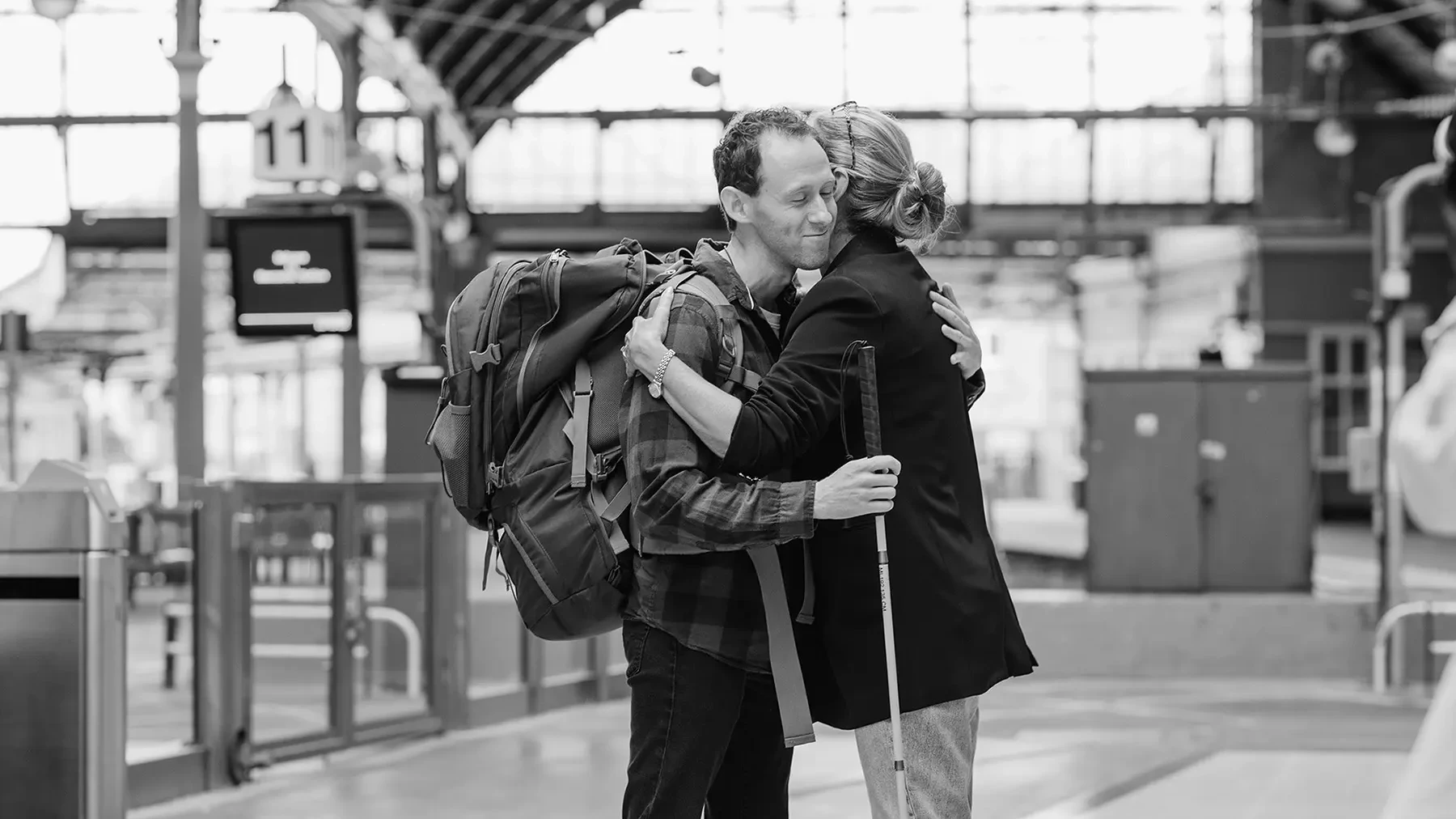
Traveling with RP: Safe on the Road
From Booking to Boarding – reach your destination relaxed with planning, assistance, and orientation aids.
EUTB®: Free Participation Counseling
Independent, individual, and accessible: EUTB® supports you – including with cost coverage applications for OkuStim® therapy.